Did Claude solve the Riemann hypothesis? What Levent Alpöge's Lean proof shows so far
Levent Alpöge says he and Claude found a proof of the Riemann hypothesis and GRH, released as 17.4 million lines of Lean. On November 21 the Lean and Mathlib communities certified the proof as correct; a human-readable explanation is still to come.

Updated November 22, 2026: Updated November 22: the Lean and Mathlib communities certified the proof on November 21; status, FAQ and sources updated.
Short answer: the Lean proof is now certified. On November 20, 2026, Levent Alpöge, a mathematician at Anthropic, posted a four-page note saying that, working with Claude, he believes he has found a proof of the Riemann hypothesis that extends to the Generalized Riemann Hypothesis (GRH). He released no readable paper, only Lean code of about 17.4 million lines. On November 21 the Lean and Mathlib communities, endorsed by the Lean FRO and the Mathlib Initiative, said they have full confidence the proof is correct and certified both its statement and its proof. No one has yet explained the argument in human terms.
Update, November 21: the joint statement on the Lean community blog says all four of the Xena Project's criteria are met: the statement is Mathlib's, dozens of builds reproduce the same proof export, the statement was matched with two independent tools (comparator and con-leche --compare), and the exported proof passed several proof checkers. Andrew Sutherland's MIT page, which says his checks were run with Claude Code, lists the main runs: leanchecker replayed every module, the independent kernels nanoda and con-leche accepted the export, and the slow end-to-end comparator run and single-threaded Lean kernels on the export were still running at its 12:55 UTC update. "GRH" here means Dirichlet L-functions; other L-functions were not checked. Our follow-up covers the checks, the scope and how to repeat the fastest one: claudefox.com/riemann-hypothesis-lean-verification-certified.
This page tracks what is actually established, what is still open, and how you can check the Lean archive yourself. Sources are Alpöge's note, Terence Tao's and Scott Aaronson's blogs, Quanta Magazine, Scientific American and the public GitHub mirror of the code, read on November 21, 2026, plus the Lean community's joint statement and Sutherland's verification page, read on November 22.
What Alpöge claims
- The claim: a proof of the Riemann hypothesis (every nontrivial zero of the zeta function has real part 1/2), extended to GRH for Dirichlet L-functions. Alpöge adds that he expects a further extension, the Extended Riemann Hypothesis, with more time.
- Who: Alpöge lists himself as working at Anthropic and as a junior fellow at the Harvard Society of Fellows. Terence Tao describes the work as done using an internal AI model; Alpöge's note says Claude. None of the sources we read name the model version.
- Form: the written-out argument ran past 250,000 pages, which Alpöge calls unreadable, so he published only the Lean code, split into 14 archive parts on his site.
- Timeline: a list in the note, which Alpöge says Claude compiled, runs from first steps on October 6, 2026 to GRH on November 16, 2026. Quanta reports he had the result on Monday, November 16 and waited several days before sharing it; his note says the timing was bad and that he consulted Anthropic's leadership about announcing.
- Role split: Alpöge says he steered the approach, combining two ideas from a toy setting and pointing the work at the right analogue, and that Claude "far outpaced" him near the end, notably on automorphic forms on higher-rank groups, which he says he has little mastery of.
Verification status, check by check
A Lean proof is only as good as four separate checks. Here is where each one stood in the reports we could confirm:
- Does it compile? Yes, independently. Quanta reports Andrew Sutherland (MIT) finished first, shortly before noon on November 20; Simon DeDeo (Carnegie Mellon) succeeded a few hours later and told Quanta he would be very surprised by any hidden tricks; Sutherland then compiled it again with a variant of Lean.
- Which axioms does it use? Only the standard three, according to Sutherland, quoted by Scientific American: "The Lean proof has been compiled and independently rechecked by the Lean kernel with only the three standard axioms." He added that the chance of anything fishy was approximately zero.
- Is the statement really the Riemann hypothesis? The main theorem uses Mathlib's own RiemannHypothesis definition, not one written inside the repository, according to the mirror's README. The other four statements (zeta zeros on the line, and GRH for Dirichlet L-functions) are defined in a 16-line file that imports only Mathlib. Kevin Buzzard calls this the first question to ask of any Lean proof.
- Has a comparator confirmed nothing was redefined? Yes for the statement match, according to the November 21 joint statement of the Lean and Mathlib communities: comparator and con-leche --compare both confirmed that the theorem proved is exactly Mathlib's statement. Compiling only shows each step is valid; the comparison checks that no symbol in the statement was quietly redefined, and independent kernels check the exported proof so it does not rely on a bug in Lean's main kernel. On Sutherland's page, nanoda and con-leche master accepted the export (the older con-leche and con-ron builds bundled with Lean v4.36.0 declined with exit code 2, which the page says is not a rejection), while the end-to-end lake comparator run and the Lean kernels on the export were still running at its last update.
- Do mathematicians understand it? No. Tao writes that early analysis suggests the proof draws on modern work across the Langlands program and arithmetic geometry, and that digesting it will take time.
Why a Lean-only proof is different
Here the order is unusual: the formal Lean proof came first, with no readable paper. Once the comparator and multi-kernel checks pass, mathematicians can trust that the formal theorem is proved before anyone understands why it is true. Scott Aaronson notes that, so far, no AI result with a Lean certificate has needed to be retracted, while several without one have, and he bets this proof will stand. He is not fully certain: Lean kernel bugs have in the past allowed proofs of 0=1, and until such issues are fixed he thinks a sufficiently motivated AI could almost certainly exploit them to prove a false statement. That is why the multi-kernel comparator matters.
Not everyone is comfortable with this. NYU's Maksym Radziwill told Quanta that a Lean proof short-circuits understanding, and that Alpöge's four-page write-up contains statements that do not inspire confidence. The goal of mathematics, he said, is to answer why, and this does not.
The other GRH proof posted the same day
The same day, Stanford's Ravi Vakil, president of the American Mathematical Society, posted a 940-page manuscript by Stanford postdoc Alessandro Masullo claiming GRH, "all human, with no AI". Vakil wrote that Brian Conrad had been reviewing it for months and that it was so far looking good to him; the plan had been to polish it for a year before announcing. About eight hours later Vakil added that several people had reported problems in the proof, found with the help of AI models, and that he makes no claim about the strategy's correctness. Quanta notes that an earlier Riemann proof Masullo worked on did not hold up, and many number theorists are withholding judgement. Tao says the manuscript is closer to Deninger's strategy than to Connes' F1 approach.
How this fits Claude's run of math results
- August 2026: Alpöge and Ralph Furman posted arXiv 2608.13637, proving that at least two thirds of the zeta zeros are simple and on the critical line. The paper says the proof was "discovered autonomously by Claude" and is verified in Lean 4.
- September 2026: Anthropic announced it had formalized the proof of Fermat's Last Theorem; Quanta reports a swarm of agents took 11 days and produced some 13 million lines of code.
- October 2026: Aaronson notes an AI proof that the zeta zeros lie at most 3/8 from the critical line (a quasi-Riemann hypothesis), one of OpenAI's October results.
- November 20, 2026: alongside GRH, Tao lists two more results with heavy AI help that Alpöge co-authored: finite-time blowup for the unforced 3D Euler equations, with a human-readable paper and Lean formalization, and for unforced 3D Navier-Stokes, also in Lean, whose paper Tao says still needs to become a properly written proof.
How to check the archive yourself
You do not need to trust anyone's summary: the code is public. The steps below come from the README of the GitHub mirror CocoSgt/riemann-hypothesis-lean (299 stars on November 21, 2026), which says it is a byte-for-byte copy of Alpöge's archive. Alpöge published the archive without a stated license, and the mirror adds none. For the most trustworthy copy, download the 14 parts from alpo.ge and compare the hash. The archive is about 239 MB; the mirror says a checkout is about 1.3 GB, before Mathlib and build outputs.
for i in $(seq -w 1 14); do curl -LO https://alpo.ge/lean.tar.gz.part$i; done
cat lean.tar.gz.part{01..14} > lean.tar.gz
shasum -a 256 lean.tar.gz
# expect 9631b4f020199e580ba86178cb56c6e9b09f690c2369a80dc4334aa93f49c7fc (239,275,554 bytes)
tar -xzf lean.tar.gz && cd lean
Read src/Main.lean and src/Statements.lean first; they are short. The archive pins Lean v4.33.1 and Mathlib commit 0df444a360eaa60ab8c11dca51a86af692955474. The mirror's text scan of all 175,187 files found no sorry, admit, axiom declarations, native_decide or unsafe code. It did find 4 files with set_option maxHeartbeats 0, 22 custom macro, elab or syntax definitions (tactic shorthands) and one addDecl command that copies existing declarations, which still goes through the kernel. That scan is a sanity check, not a proof check. A full build is very large: the mirror says no build time or memory figures had been published, so plan for a big multi-core machine. Then:
lake exe cache get
lake build Statements   # fast sanity check
lake build Main         # the full proof, very long

# Check.lean in the project root:
#   import Main
#   #print axioms riemannHypothesis
lake env lean Check.lean
A clean result lists only propext, Classical.choice and Quot.sound. Anything else, such as sorryAx or a custom axiom, means the proof depends on something unproved. The README also recommends replaying the result with an external checker such as lean4checker.
We tried it: the cheap checks
We ran the first half of that checklist in a Linux sandbox on November 21, 2026 (4 shared cores, under 1 GB of free RAM, no Lean installed). The release tarball from the GitHub mirror downloaded in 6.3 seconds; its SHA-256 and its size of 239,275,554 bytes matched the README exactly. It extracted to 1.4 GB in 30 seconds and contains only lean-toolchain, lakefile.toml, lake-manifest.json and src/. We counted 175,187 .lean files and 17,374,215 lines, and every folder's file count matched the README's table.
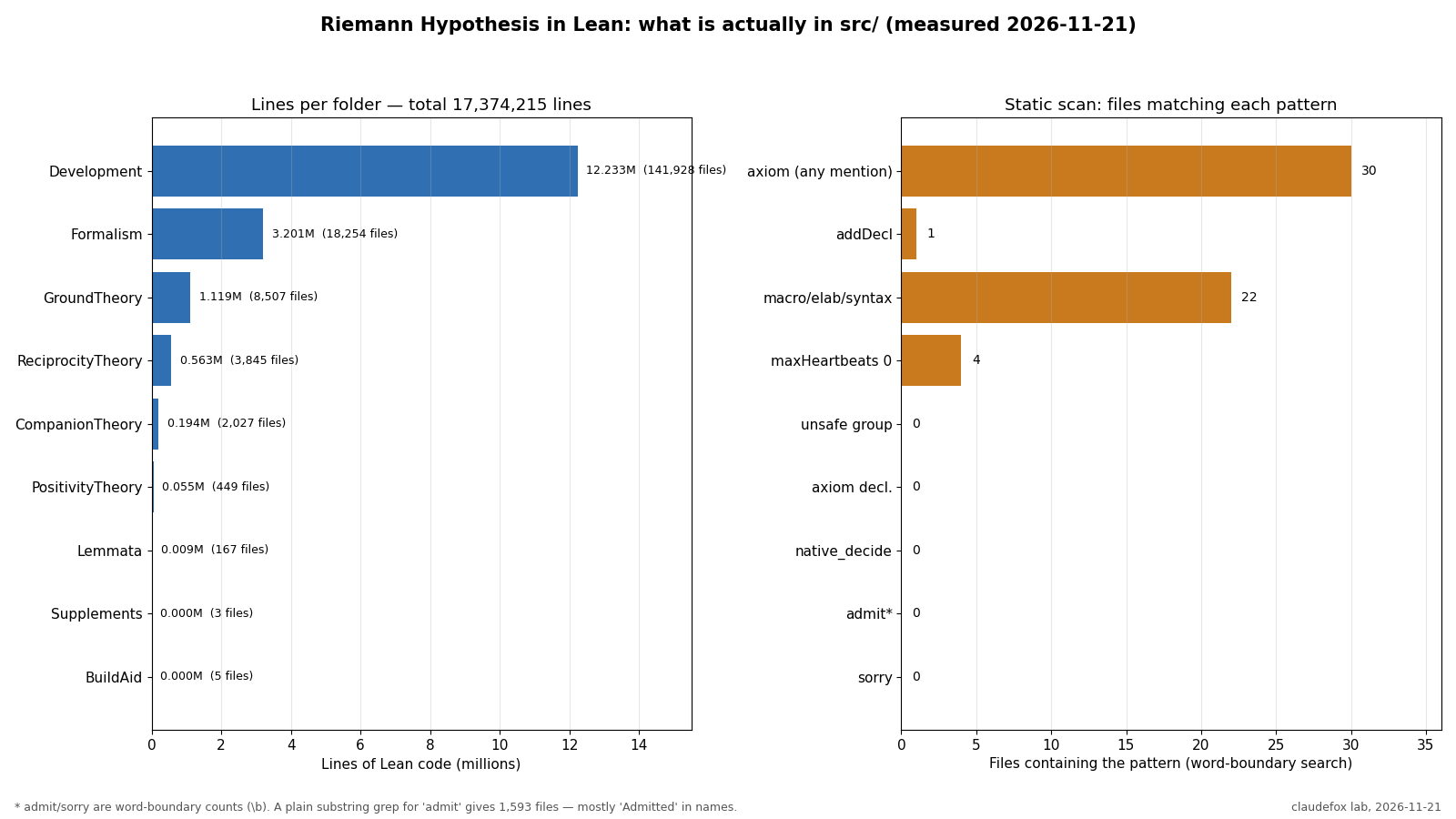
The static scan reproduced the README's numbers with a word-boundary search: 0 files with sorry, admit, axiom declarations, native_decide or unsafe code; 4 with maxHeartbeats 0; 22 with custom macro, elab or syntax; 1 with addDecl. Two gotchas if you repeat it. A plain grep for admit returns 1,593 files, all hits inside longer names such as Admitted; search with word boundaries. And a loose grep for def RiemannHypothesis finds 9 longer names like RiemannHypothesisOfHalfLinks, but no definition of the bare name, so the main theorem does use the outside definition.
What did not work: git clone --depth 1 of the mirror ran for 20 minutes without finishing on our small machine, so use the release tarball or Alpöge's parts. What we did not test: we did not install Lean, build anything, run #print axioms or open Mathlib's definition at the pinned commit. A static scan says nothing about what the compiled theorems depend on; the independent builds above are what count.
Copy-paste prompt: have your agent audit the archive
Try it with your AI. Give this to a coding agent with shell access on a machine you control, with plenty of disk and a fast connection. It does the cheap checks first and asks before installing anything or starting the expensive build.
Audit the Lean archive Levent Alpöge published for his claimed proof of the Generalized
Riemann Hypothesis. Work only in a new empty folder, [/path/to/empty/folder]. Do not
touch files outside it.

1. Check free disk space and RAM and report both. The archive is about 239 MB and
   extracts to well over 1 GB, and a build needs much more for Mathlib and outputs. If
   there is under [20] GB free, stop.
2. Download the 14 parts from https://alpo.ge/lean.tar.gz.part01 to part14, concatenate
   them into lean.tar.gz, and compare its SHA-256 with
   9631b4f020199e580ba86178cb56c6e9b09f690c2369a80dc4334aa93f49c7fc. Stop and tell me if
   it differs.
3. Extract it. Show me src/Main.lean, src/Statements.lean, lean-toolchain and the
   Mathlib commit in lake-manifest.json verbatim. Search src for any 'def
   RiemannHypothesis'. Note this cannot rule out every redefinition; that is the
   comparator's job.
4. Count the .lean files and lines, and count files containing sorry, admit, axiom
   declarations, native_decide, unsafe, implemented_by, maxHeartbeats 0 and addDecl.
   Report a table.
5. Stop. Show me the official elan install command from lean-lang.org and the lake exe
   cache get and lake build Statements commands. Wait for my confirmation before running
   them.
6. Do not run lake build Main unless I say so. If I approve, log time and peak memory to
   a file, then run #print axioms on riemannHypothesis and report the exact output. A
   clean result lists only propext, Classical.choice and Quot.sound.
What is still unknown
- Final results of the slowest runs: Sutherland's page, as of 12:55 UTC on November 21, still showed the end-to-end lake comparator run and the Lean default and paranoid kernels on the export as running; statement comparison and the axiom check had passed.
- Which Claude model and setup were used, and how much compute it took: none of the sources we read give these details.
- Whether the argument can be turned into a proof humans can read. Alpöge says he expects big simplifications and plans a proper write-up.
- Whether the mathematical community will accept it, which usually takes far longer than a build.
FAQ
Did Claude prove the Riemann hypothesis? Alpöge says he found the proof working with Claude, and that the same method proves GRH for Dirichlet L-functions. On November 21 the Lean and Mathlib communities certified the Lean proof as correct after independent builds, two statement-matching tools and several proof checkers. What remains is human understanding: there is still no readable proof.
Who is Levent Alpöge? A number theorist who works at Anthropic and is a junior fellow at Harvard's Society of Fellows. His homepage lists a solution of Hilbert's tenth problem over all number fields as his most recent paper.
What is the difference between RH and GRH? The Riemann hypothesis is about the zeros of the zeta function. The Generalized Riemann Hypothesis makes the same claim for Dirichlet L-functions. The Lean archive states both, as separate theorems.
Has the comparator check passed? The statement-matching part has: the Lean and Mathlib joint statement of November 21 says comparator and con-leche --compare both confirm the proved theorem is exactly Mathlib's statement. Sutherland's page showed the full end-to-end lake comparator run, including its single-threaded kernel stages, still in progress at its last update.
Is the Masullo proof the same thing? No. It is a separate, human-written 940-page manuscript posted the same day by Ravi Vakil. Readers have already reported problems in it, and no formalization had been reported in the sources we read.
Why is the proof 17.4 million lines? The archive formalizes a large amount of supporting number theory along the way. Quanta quotes one number theorist on the Lean Zulip saying it contains essentially all number theory of the last 50 years. Alpöge expects much shorter proofs to follow.
Source: Lean community blog: Lean verification of the Riemann Hypothesis (joint statement), Andrew Sutherland (MIT): Verification files for the Lean proof of the Riemann Hypothesis, Levent Alpöge: announcement note (remark.pdf), Levent Alpöge: homepage, Terence Tao: Unforced Euler singularity, unforced Navier-Stokes singularity, and the Generalized Riemann Hypothesis, Scott Aaronson: The stochastic parrots have apparently proved the Riemann Hypothesis, Quanta Magazine: As mathematicians race to verify AI Riemann proof, a human proof emerges, Scientific American: The AI Riemann hypothesis proof is almost certainly true, independent mathematicians attest, GitHub: CocoSgt/riemann-hypothesis-lean (mirror of the Lean archive), Ravi Vakil: Hurried Announcement: Alessandro Masullo GRH, arXiv 2608.13637: More than two thirds of the zeta zeros are simple and on the critical line
This story first appeared in the claudefox daily briefing for November 21, 2026.