Xing4.1-Preview: China Telecom's open 285B model trained on Huawei Ascend chips, and what it takes to run it
China Telecom has released Xing4.1-Preview, a 285B-parameter mixture-of-experts model with 17B active parameters and a 1M-token context, trained on 8,192 Huawei Ascend 910C chips. The weights are Apache-2.0 on Hugging Face; serving them needs about eight 80 GB GPUs.

China Telecom's AI unit has open-sourced Xing4.1-Preview, a 285-billion-parameter mixture-of-experts (MoE) model that activates 17 billion parameters per token and supports a native 1M-token context. It was trained on 8,192 Huawei Ascend 910C chips with Huawei's MindSpore framework, and is aimed at agentic coding and long, multi-step agent tasks. The weights are on Hugging Face (XingChen-AGI/Xing4.1-Preview) under Apache-2.0, and the technical report is arXiv 2611.22115.
The GitHub repo dates the open-source release to November 23, 2026; the Hugging Face repo with PyTorch weights went up on November 25 and had 9,084 downloads and 571 likes when we checked on November 29. Chinese AI outlet QbitAI, which co-hosted a livestream of the team's training work, wrote it up on November 28. Here is what the model is, what it takes to run, and how to read its benchmark table.
Quick facts
- Developer: China Telecom Artificial Intelligence Technology (Beijing). Xing is the series formerly called TeleChat.
- Size: 285B total parameters, 17B active per token. The config lists 45 layers, 256 routed experts plus 1 shared expert, 8 experts per token and a 131,072-token vocabulary.
- Attention: Multi-head Latent Attention (MLA) plus DeepSeek Sparse Attention (DSA), both taken from DeepSeek V3.2. The config's architecture field is DeepseekV32ForCausalLM.
- Context: native 1M tokens. Thinking mode is on or off, with no effort levels.
- License: Apache-2.0. Weights come in two formats: PyTorch safetensors (the main Hugging Face repo, 573 GB in total) and the native MindSpore format in a separate repo.
- Access: download from Hugging Face, ModelScope or Modelers, or call it through the OpenAI-compatible API on the TeleAI Open Platform, which also supports function calling and structured output.
Can you run it yourself?
Only on a multi-GPU server. The team's vLLM guide puts the BF16 weights at about 521 GiB and says loading them alone needs roughly 8×80 GB of GPU memory, so its example uses --tensor-parallel-size 8 and at least eight GPUs. A 1M-token context needs more memory on top of that; the guide suggests lowering --max-model-len, for example to 131072, if the KV cache doesn't fit. To cut memory, it points to a W8A8 version from the FlagOS community.
Framework support, per the model card and the team's vLLM guide: SGLang supports it natively on its main branch; vLLM loads the model but needs the team's out-of-tree plugin, xing4-vllm-plugin, to parse Xing's reasoning and tool-call formats; ms-swift (v4.6.0+) and LLaMA-Factory (main branch) handle fine-tuning; a TensorRT-LLM pull request is under review. llama.cpp and KTransformers only support the older Xing4.0 models, not Xing4.1-Preview, so there is no supported GGUF route for laptops.
The vLLM steps from the guide, inside the official vllm/vllm-openai container with the model directory mounted:
pip install --no-deps "git+https://github.com/XingChen-AGI/xing4-vllm-plugin"

VLLM_PLUGINS=xing4_0 vllm serve /models/Xing4.1-Preview \
  --host 0.0.0.0 --port 8000 \
  --served-model-name Xing4.1-Preview \
  --tensor-parallel-size 8 \
  --trust-remote-code \
  --gpu-memory-utilization 0.90 \
  --max-num-seqs 4 \
  --enable-auto-tool-choice \
  --reasoning-parser xing4_0 \
  --tool-call-parser xing4_0
The guide says the --no-deps flag keeps pip from replacing the vLLM already installed in the image. Once it's up, the OpenAI-compatible endpoint is at http://localhost:8000/v1. Thinking is switched per request with chat_template_kwargs {"enable_thinking": true or false}. The model card recommends temperature 0.8, top_p 0.95 and repetition_penalty 1.05 for agent and coding work, temperature 1.0 for reasoning and 0.6 for general chat (the vLLM guide's example uses top_p 1.0). Note that --trust-remote-code runs code from the model repo, and --host 0.0.0.0 exposes the API on every network interface; keep it behind a firewall. The model card has an equivalent SGLang command, and the repo has a separate guide for Huawei Ascend NPUs through vLLM-Ascend.
How it was built on Ascend
The interesting part of the release is the engineering write-up. The team says the Ascend 910C is strong at matrix (Cube) compute but limited on vector compute (and, per QbitAI's write-up, memory bandwidth), and it shaped the model around that. It picked DSA over linear-attention hybrids because DSA is mostly matrix multiplications. It made the network wider and shallower (45 layers) so the matrix units stay busy and fewer sequential per-layer operations run. It replaced pipeline parallelism with hybrid sharding: parameters are sharded inside each Ascend super-pod and replicated across super-pods. It also built a vocabulary tuned for agent traces and code, which it says cuts token counts by 16% in agent scenarios and 23% in coding at the same vocabulary size.
QbitAI's write-up of the report and the team's livestream adds numbers we have not checked against the paper: about 10% more throughput from the wide-and-shallow change, 16.1% from dropping pipeline parallelism, 5–10% from CPU pinning, and cluster availability above 96%. In the livestream, the team said it started at 60% of the efficiency of the same Nvidia compute and finished at 93%. QbitAI also reports that the technical report closes by saying a trillion-parameter Xing model is now training on Ascend.
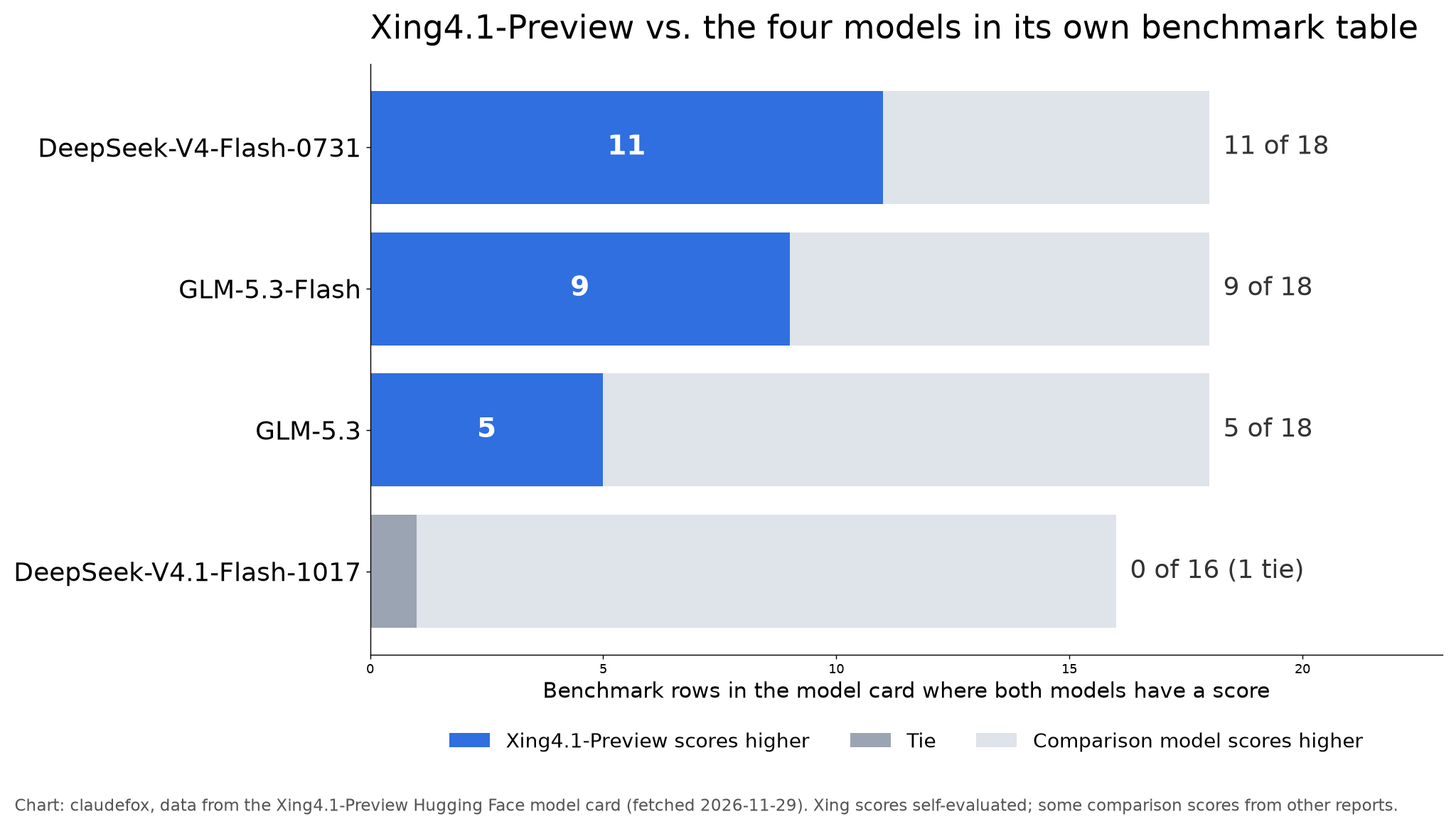
How to read the benchmark table
The model card compares Xing4.1-Preview with four models on 18 benchmarks. We counted the rows row by row. It scores higher than DeepSeek-V4-Flash-0731 on 11 of 18 rows, including SWE-Bench Pro V2 Hard51 (74.5 vs 60.8). Against GLM-5.3-Flash it's 9 of 18, against the full GLM-5.3 5 of 18. Against DeepSeek-V4.1-Flash-1017, it wins none of the 16 rows where both have scores and ties one (Terminal-Bench-Science 0.1, 12.9 each).
Three caveats from the card's own notes. Xing's scores are self-evaluated. Several comparison scores come from other places: the other models' technical reports, the Artificial Analysis leaderboard or third-party reports. And setups differ: on Terminal-Bench 2.1, Xing ran in the terminus-2 harness while the other models ran in Claude Code, so that row compares harnesses as well as models. WorkspaceBench was run in Claude Code with Claude Opus 5.5 as the judge. Some gaps are tiny either way: 85.2 vs 85.18 on MMLU-Pro, 56.5 vs 56.3 on WorkspaceBench, 79.67 vs 79.7 on AA.LCR.
Outside results are thin so far. QbitAI reports that SuperCLUE's November 2026 rankings put it third in both the agent list (96.2, tied with Hy3) and the coding list (73.3). When we checked on November 28, we found no public reports from anyone outside the team serving the weights with vLLM or SGLang. Treat this release as a capable open model on Chinese hardware with a detailed training recipe, not as a new top coding model.
Try it with your AI. Before you download 573 GB, paste this into your coding agent to check whether your machine can serve Xing4.1-Preview with vLLM.
I want to serve the open-weights model XingChen-AGI/Xing4.1-Preview (285B MoE, BF16,
about 521 GiB of weights) with vLLM. Don't download or install anything yet.

1. Run nvidia-smi and docker --version and show me: GPU count, memory per GPU, driver
   version, and free disk space on [model download path].
2. Tell me if this meets the documented minimum: about 8 x 80 GB of GPU memory for the
   weights alone (tensor parallel size 8), plus about 575 GB of free disk for the
   download. If not, stop and say so; mention that the model card points to a community
   W8A8 version from FlagOS for less memory.
3. If it does, write out (don't run) the steps from the official guide: pull
   vllm/vllm-openai, pip install modelscope and download the model with modelscope
   download --model XingChen-AGI/Xing4.1-Preview --local_dir [model download path],
   install the plugin with pip install --no-deps
   "git+https://github.com/XingChen-AGI/xing4-vllm-plugin", then start vllm serve with
   VLLM_PLUGINS=xing4_0, --host and --port, --tensor-parallel-size 8,
   --trust-remote-code, --enable-auto-tool-choice, --reasoning-parser xing4_0 and
   --tool-call-parser xing4_0, and a --max-model-len that fits my memory.
4. Point out that --trust-remote-code runs code from the model repo and that --host
   0.0.0.0 exposes the API on all interfaces. Show me the full command list and wait for
   my OK before running any of it.
Known limits
- It's a preview. The card's disclaimer says outputs may be inaccurate and must not be used for internet services that haven't gone through the required safety review and filing.
- No llama.cpp or KTransformers support for this version, so no consumer-hardware route yet.
- The vLLM path depends on an out-of-tree plugin; TensorRT-LLM support is still a pull request.
- Benchmarks are mostly self-reported, and some rows mix harnesses.
FAQ
Is Xing4.1-Preview based on DeepSeek? It borrows DeepSeek V3.2's attention design (MLA and DSA) and its config uses the DeepSeek V3.2 architecture class, but China Telecom says it trained the model itself on 8,192 Ascend 910C chips. It uses its own 45-layer, wide-and-shallow layout and a custom vocabulary tuned for agent and code text.
Can I use it in Claude Code or other coding agents? The team says it evaluated the model in Codex, OpenCode, Pi, Claude Code and WorkBuddy. Through vLLM or SGLang you get an OpenAI-compatible endpoint with tool calling; whether your agent can connect to it depends on that agent's support for custom endpoints.
What is the difference between Xing4.0 and Xing4.1? Xing4.0 (for example the 29B-A4B model released in September) uses a different architecture. Xing4.1-Preview moves to MLA plus DSA but keeps API compatibility with the Xing 4 series, so serving and fine-tuning tools built for Xing4.0 mostly carry over, except llama.cpp and KTransformers.
Is there a hosted API? Yes, the TeleAI Open Platform offers an OpenAI-compatible API with model name Xing4.1-Preview. You need an account and API key from that platform.
Related on claudefox
- GLM-5.4 is out: how to use it in Claude Code, what it costs, and what Z.ai hasn't published
- Inkling 2 Mini: how to run Thinking Machines' 26B open model locally, and which quant fits your RAM
- OpenRouter DeepSeek traffic on Novita, StreamLake and Ant Digital traced to ByteDance Ark, researcher says
Source: Xing4.1-Preview model card (Hugging Face, XingChen-AGI), XingChen-AGI/Xing4.1-Preview (GitHub), Xing4.1-Preview vLLM deployment guide (GitHub, Chinese), TeleChat to Xing4: Advancing Frontier Agentic Models on Domestic Chips and Frameworks (arXiv 2611.22115), Xing4.1-Preview config.json (Hugging Face), QbitAI: 8,192 Ascend chips train a 285B model (Chinese, Nov 28, 2026)
This story first appeared in the claudefox daily briefing for November 29, 2026.